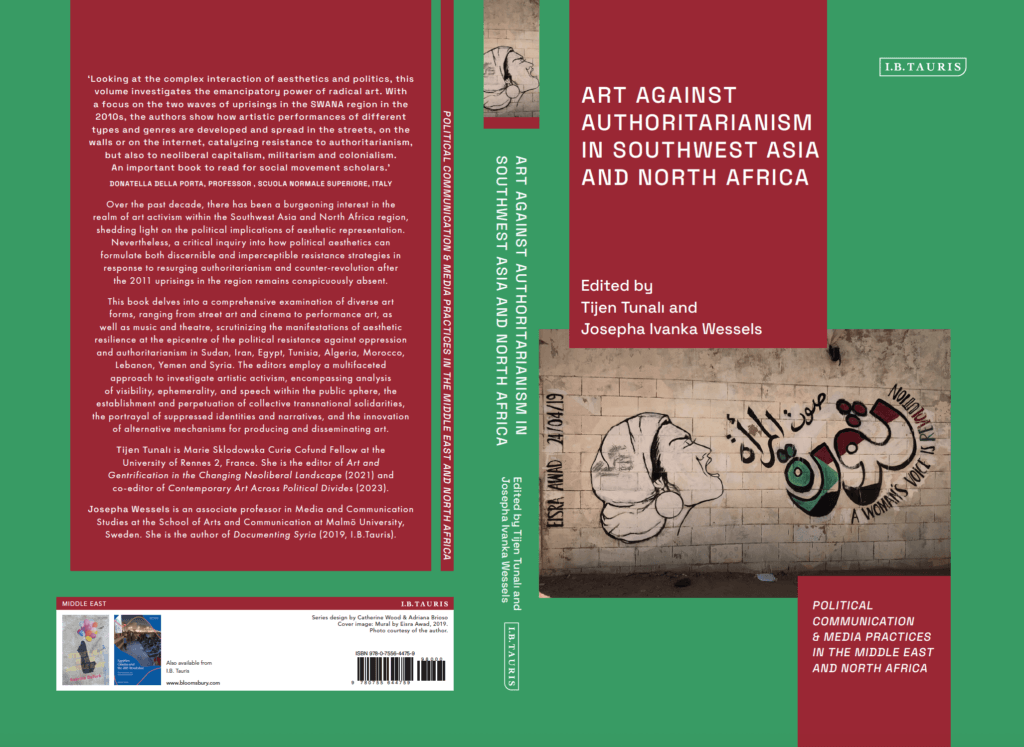
IUR member, Josepha Wessels and Tijen Tunali release a new edited volume that demonstrates how public art in urban areas has been, is and continues to be a strong medium for people’s voices against oppression and authoritarianism.
The book titled Art Against Authoritarianism In South West Asia And North Africa, is a new and exciting edited volume about resistance art against authoritarianism in the South West Asian and North Africa Region.
‘Looking at the complex interaction of aesthetics and politics, this
volume investigates the emancipatory power of radical art. With
a focus on the two waves of uprisings in the SWANA region in the
2010s, the authors show how artistic performances of different
types and genres are developed and spread in the streets, on the
walls or on the internet, catalyzing resistance to authoritarianism,
but also to neoliberal capitalism, militarism and colonialism.
An important book to read for social movement scholars.’Donatella Della Porta, Professor Sociology, Scuola Normale Superiore, Italy
Abstract
Over the past decade, there has been a burgeoning interest in the realm of art activism within the Southwest Asia and North Africa region, shedding light on the political implications of aesthetic representation. Nevertheless, a critical inquiry into how political aesthetics can formulate both discernible and imperceptible resistance strategies in response to resurging authoritarianism and counter-revolution after the 2011 uprisings in the region remains conspicuously absent. This book delves into a comprehensive examination of diverse art forms, ranging from street art and cinema to performance art, as well as music and theatre, scrutinizing the manifestations of aesthetic resilience at the epicentre of the political resistance against oppression and authoritarianism in Sudan, Iran, Egypt, Tunisia, Algeria, Morocco, Lebanon, Yemen and Syria. The editors employ a multifaceted approach to investigate artistic activism, encompassing analysis of visibility, ephemerality, and speech within the public sphere, the establishment and perpetuation of collective transnational solidarities, the portrayal of suppressed identities and narratives, and the innovation of alternative mechanisms for producing and disseminating art.