With guest editor, Mateo Villamil- Valencia, the new issue of the Urban Matters delves into the complex and shifting role of monuments and countermonuments in urban spaces. Bruna Rossetti Mendonça Maria Sajid Zaheer, Hira Ovais Mario Espliego Katherine A. Román Aquino Lorena Arias Solano Fernando Gutiérrez and Ana Gilmet explore how monuments and countermonuments, mainly across the Global South, capture the fluid, collective memory of social and political struggles.
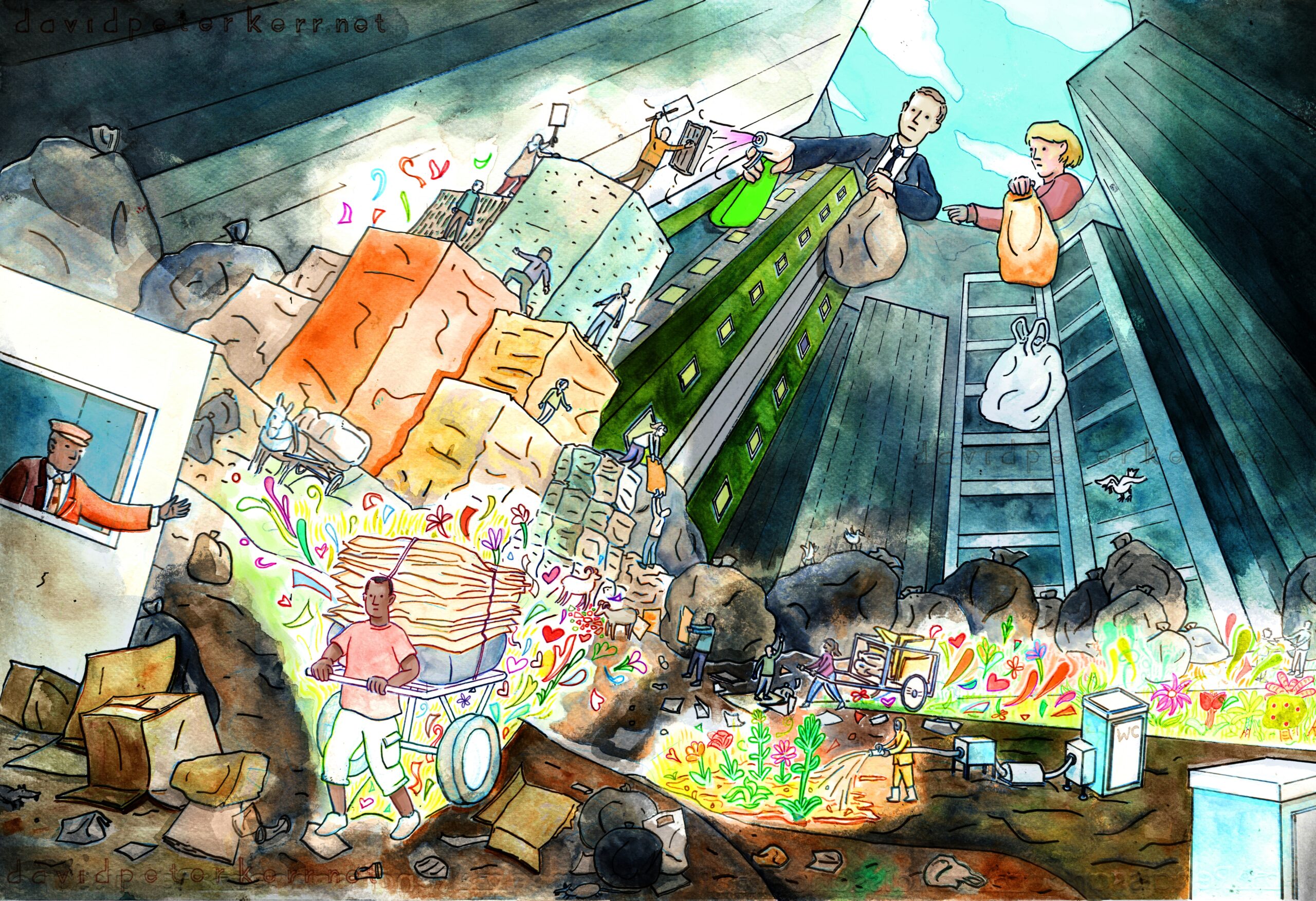
The issue cover is made for the Urban Matters by artist David Peter Kerr.
Editorial-
This special issue was conceived at the University of Copenhagen during the Nordic Latin Americanist Network (NOLAN) Conference in May 2024. A group of Latin American researchers based in England, Sweden, Belgium, the Netherlands, and Finland gathered to share and discuss their work and its connection to current international politics. The role of the Global South in the current geopolitical turmoil (Palestine, Ukraine, South Sudan, DRCongo, etc.), the relevance of collective action, contentious politics, digital connectivity, and the importance of physically gathering in public spaces inspired us to collaborate on this issue. Throughout the following pages, readers will find diverse accounts of collective political practices that have taken place in cities across the Global South (Pakistan, Bolivia, Uruguay, Colombia, Mexico, and Peru), along with a theoretical contribution from southern Europe that reflects on the nature of these power struggles, crystallized in the ever-contested encounters between citizens and their monuments. The authors will reflect on the porosity, fluidity, and intangibility of collective memories through the conceptual and physical challenges to monumental art that activists posed, bringing representation closer to the common and the everyday. Readers will understand some acts of memory, difficult to forget, in actions performed by activists and broadcasted by television and social media, as well as the effects of monumental(ish) endeavors that prescind from the aspirations of eternity and material permanence.
We will give special importance to social change and mobilization, since they turn cities into the stage on which public spaces are claimed and reclaimed with political purposes. The urban landscape—full of symbols, places, and spaces—is constituted by a web of interactions between people and things, playing a big part in whether transformative efforts succeed. The ways in which dissent takes shape can be seen in how these spaces are negotiated, adapted, or reimagined, as various political movements come together in certain areas. When people gather closely, not only are their demands amplified, but their presence also gives these demands a physical form. This goes beyond individual identities, connecting different groups into a unified show of political power. From toppling colonial statues to rethinking sites of state-sponsored violence, from building monuments like “The Hand” in Cali to creating spaces honoring feminist struggles in Mexico City, collective actions in public places add layers of meaning to these locations. Whether spontaneous or planned, temporary or permanent, such acts involve various strategies for occupying space, maintaining a steady flow of activist presence, and using reversal or subversion to make a point. Together, these elements—habitat, bodies, identities, and emotions—shape the meaning of monuments, anti-monuments, and memorials in cities worldwide.
In this issue, we will explore how truth-telling, verbal thinking, and the transformation of memory spaces come together along political constellations. Creativity, innovation, and the formation/hybridization of subjectivities fuel citizen responses, especially in moments of crisis. This issue focuses on the dynamic ways in which statues, plaques, monuments, buildings, and memorials are critiqued, redefined, changed, or even destroyed, reflecting the evolving narratives of public memory everywhere around the city.
Everywhere
In Colombia, anti-monuments like The Hand encapsulated not only protesters’ anger, keeping martyrs’ names alive, but also the history of an uprising that actually brought a radical change in the country’s ideological orientation. In Uruguay, counter-monuments placed in everyday spaces (the houses, schools, and workplaces where victims of the dictatorship used to be) shaped up popular knowledge and integrated it into the urban experience of Montevideo. In both cases, the counter-monumentality entailed a re-signification of spaces and transformed the congregation around such locations into resistance acts, creating a breeding ground for new political action. In Montevideo, as the reader will see, the nature of the interventions (mainly plaques) escalated the effect and produced a logic of multiplication that, as Ana Gilmet explains, counteracts the spaces of absence produced by the murdering actions of the military regime.
The events observed by Bruna Rossetti in Bolivia revealed a myriad of meanings within the political practices of existing, being, and inhabiting urban space. Her research showcased different facets of community autonomy, indigenous cultural identity, women’s rights, and the struggle against a homogenizing modernization that excludes differences. Additionally, she realized that interventions on monuments in the historic center of La Paz, as well as graffiti on walls throughout the city, blurred the line between private and public life, prompting citizens to think about and question their surroundings in the face of the unyielding rebellion, provocation, and discomfort generated by activists. From Pakistan, Maria Sajid Zaheer and Hira Ovais crafted a differential topology of Old Karachi: a humble and close-knit architecture, built by and for the community. What they describe as a counterpoint to the presumptuous colonial architecture is a physical and symbolic constellation of collective memory—a reservoir of past experiences and narratives that unite the neighborhood. Accounts of the past and their interactions with present-day life connect different elements of this enclave between the Arabian Sea and the Persian Gulf. Workers from across the Sindh province and neighboring regions in India imprinted accents and inflections on the port over decades: plaques, notices, and signs in the old neighborhood tell stories in Gujarati, Sindhi, Urdu, Sanskrit, and English.
Katherine Román, for her part, reflects on another anti-monument of a raised fist. In this case, the Peruvian capital served as the stage for a participatory and dynamic piece, a symbol of collective resistance and a sense of purpose amid a popular uprising. Unlike the Colombian fist, this was an ephemeral structure that challenged the official narratives of permanent monuments and the artificial memory that official notions of national identity have always imposed. The appearance and destruction of this temporary monument disrupted the unilinear and evolutionary version of history that permanent monuments seek to impose. Finally, Fernando Gutiérrez shares with us the significance of a statue of a protesting girl and the round point-memorial that feminists erected on a central avenue in Mexico City. Remembering and forgetting are verbs that intertwine with the city in both physical and symbolic ways. In the Mexican case, the feminists’ work questioned traditional ideas of commemoration, challenging and subverting events and values, as well as the very idea of them. Interestingly, the nature of the case he studies evolved: although it initially emerged as a direct form of protest and resistance in an informal, temporary, and activist format, negotiations with the state led to both elements (the statue and the memorial) remaining in place and acquiring a more stable nature. Time will tell.
Mourning Landscapes
At this point, we cannot forget that the history of what we now know as the Global South is marked by its centuries-long relationship with the North/West, characterized by exploitation and violence, along with human, cultural, and environmental extermination. This colonial-imperial history leaves, among countless other traces, landscapes of mourning and grief that serve as a backdrop to the anti-monumentality that brought us here. The cases documented by the authors provided (and left in their people’s memory) opportunities for resistance, collective expression, and the potential to break boundaries imposed by the status quo. The visibility, openness, and multifunctionality of counter-monuments allow for the emergence of new forms of sociability, identity, and resilience in the face of the systemic restrictions that citizens confront.
In this issue, we will see how collectively constructed works also become collective property and an extension—perhaps eternal—of what the community has experienced. The entire community, not specific individuals, not personalities embodying a political process or a historical moment, but everyone. We will also see that this (anti)monumentality is connected to the painful past experienced collectively, reconfiguring the urban landscape and staging memory through the enactment of mourning. As Lorena Arias would say, these enclaves in Cali or Montevideo are “living places that still hurt.” According to the authors, this type of intervention works precisely like that: urban transformation serves as protest, as a denunciation of racism, sexual violence, and state terrorism. The modifications to the cityscape are not actions that recycle or fill space; rather, they stir, move, and deeply affect.
Finally, the pain felt by entire sectors of these societies shapes the nature and characteristics of these urban layers of memory. On one hand, practices of memory are not limited to the places where repression and violence occurred; they extend to sites where the victims lived, worked, studied, or resisted. What were once spectral settings are re-signified to link narratives and symbols of a conscious, horizontal collective memory. On the other hand, the deaths of activists during protests and demonstrations at the hands of security forces and paramilitary groups marked turning points that facilitated the widespread condemnation of hegemonic brutality and intensified the spirit of rebellion. It is in this context of reclaiming the life and dignity of those who fight that the need emerges to visually describe the emotions of those who protest.
Welcome to another issue of Urban Matters. I hope that you enjoy reading it as much as our editorial team did, and that it awakens in you the need to also view the city through absence, longing, lack, and melancholy, because what is not there, what is unseen, what is unspoken, silently settles into the urban landscape in its forms, its structures, and its flows.