Urban Matters journal is out with a new edition guest edited by IUR’s 2025 artist in residence Friederike Landau-Donnelly! The issue, “Governing Light/ly? Sensing the politics and poetics of public space through darkness and light,” blends photo essays, interviews, research articles, and artistic documentations to explore the political conditions of light and darkness in urban spaces, involving human and more-than-human actors in the discussion.
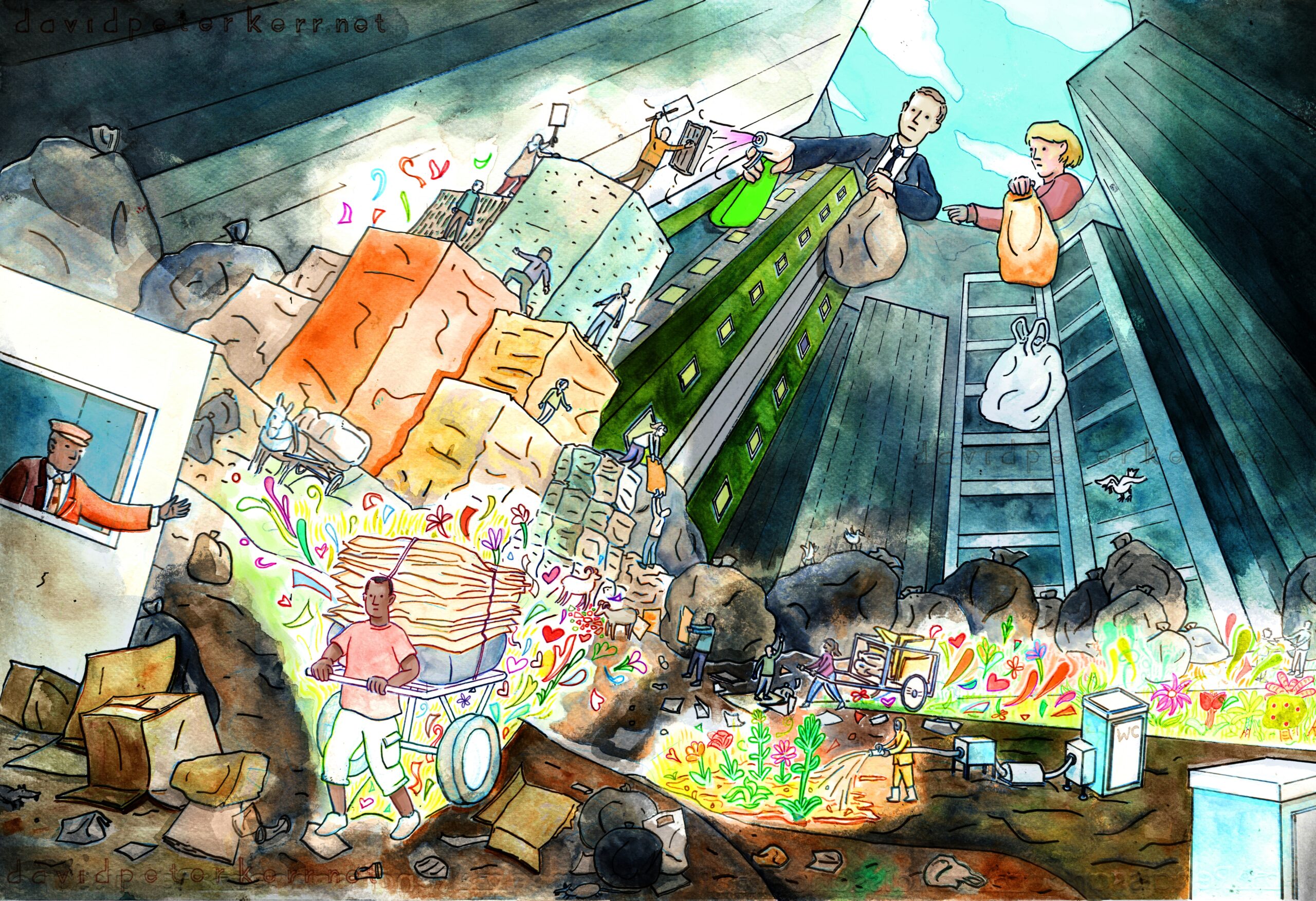
The issue’s illustration is created for Urban Matters by artist David Peter Kerr.
Editorial
Be bright or wither. Be brilliant or wane. Publish or perish. Switch on, don’t switch off. Spot on. Stand in the spotlight. Highlight. Shine.
Academic (knowledge) production seems to interrelate with light and illumination, not least due to its problematic legacies lingering from the Enlightenment. Every enlightenment casts a shadow, as legal scholar Sophie Riley (2022) puts it. How have conceptions of light and darkness influenced a Western-centric production of knowledge for centuries? Who and what have been kept in the dark, who and what has shone? Put differently, how do we disentangle impactful assumptions about lightness and darkness and its political in-betweens in contemporary urban practice and theory? What lurks in the (assumedly dark) underbelly of academia, all the insights never published, never readily analyzed or theorized until the end? How un(der)illuminated is academia?! What role do our sentient bodies as well as different luminous objects, with artificial or ‘natural’ light, play? In this vein, this special issue is driven by engagements with the affective, embodied, and political power of light, darkness, and illumination (Bille & Sørensen, 2007; Ebbensgaard & Edensor, 2021).
Entitled “Governing Light/ly? Sensing the politics and poetics of public space through darkness and light,” this special issue engages with conversations on the contested nature of public spaces, and the many ways in which these tensions become tangible via (multi)sensory and creative practices of diverse public space users. Throughout a one-month artist residency at the Institute for Urban Research at Malmö University in February and June 2025 (see Landau-Donnelly), I engaged with the presence and absence (or should I say pre-sense and ab-sense?) of lightness and darkness in Sweden’s oldest people’s park – Folkets Park in Malmö. The contributions to this issue offer an interdisciplinary set of perspectives, ranging from urban anthropology to cultural sociology, and from urban and cultural geography to environmental psychology, to shed light on the multiple ways we can see light/ness and dark/ness in public space. Some contributions focus particularly on the relationship between re/sources of light and darkness vis-à-vis the production of art, both in public spaces (see Hannerz & Kimvall and Bengtsen) as well as institutionalized art spaces (see Merkord). Other contributions analyze spatial settings as urban forests and playgrounds (see Tsiakiris, Litsmark & Landau-Donnelly) and contested local public spaces such as parks (see Schulte-Römer et. al). Drawing on Mikkel Bille’s cultural analysis of light, Nona Schulte-Römer (2019, p. 216) offers the phrase of “liv[ing] with light,” which shall gently guide this issue. All accounts gathered here describe how predominantly human actors live with – and without – light in diverse urban settings, shaped by different conditions of securitization, gentrification, post-industrialization, and multi-culturalism.
Situated in a potentially renewed sense of Hannah Arendt’s Men in Dark Times (1970), which was re-instated in an edited volume with the piercing title of Politics in Dark Times (Benhabib et al., 2012), we might need to revisit the normative underpinnings of both literal and metaphorical constructions of light and darkness in public space, and democracy writ large. As urban theorist Mark Davidson (2025, 1) argues, “without seeing clearly (as many theories promise) how do we even know what is problematic, or come to understand if our interventions are helpful?” Don’t we live in darker times than ever? While accounts like Goldfarb’s (2007) Politics of Small Things or Isaac’s (1998) Democracy in Dark Times are meant to encourage small-scale political action and resistance, in everyday life, micro-political articulation and action might be hanging by a thread.
Whilst composing this special issue between March and September 2025, civic protests around the globe are violently suppressed by state and police actors – Istanbul’s mayor being detained without a solid judicial case, protestors in Los Angeles who are standing up against arbitrary immigration raids are brutally encountered by the police, protesters in solidarity with the ongoing genocide in Gaza are violently removed from public spaces and universities around the globe, etc. Critical legal scholars have identified a tendency towards a so-called racial security state in Sweden (see Schclarek Mulinari, 2025), which relies on police presence and the application of manifold techniques of control in public space. In times of looming authoritarianisms across the globe, light plays an important role – in both a literal and figurative sense – to discuss conditions of urban life that are managed, planned, curated, and appropriated via different political practices and techniques of spreading light – or darkness.
Feeling Light/ness: On affective experiences of light
The trope of night studies has brought about intriguing accounts of nighttime walking (Dunn, 2023; Dunn & Edensor, 2024; Ebbensgaard & Edensor, 2021), which interrelate multi-sensory experiences with ethnographic observations on the changing materialities of cities by night. Night studies shape and sharpen our senses to be attuned and capable of seeing (in) the light and dark, which however continues to depend on differing bodily capacities. Mikkel Bille (2015, 2) argues that “light is about more than individual perception and plays a crucial role in orchestrating a sense of community, solitude and ‘secureness’ at home” (see also Bille & Sørensen, 2007) – and to which I would add – in public space. There are real-life, mental health implications coming out of (lack of) light. What roams under the term SAD, or seasonal affective disorder (Bodden et al., 2024), illustrates the specific lack of well-being arising in seasons with less light. Bille (2015, 2) further states that “light frames such sense of secureness and cosiness by allowing for visual oscillations between separation and connection of people, places and things.” One could argue that we have always lived in “embodied light-worlds” (Bodden et al. 2024, 598). In this special issue, the contributions discuss how differently situated bodies navigate light and darkness in urban green spaces, for example, by writing or photographing graffiti, climbing on playgrounds, biking through urban forests, locking their bikes at train stations, or strolling urban parks, and thus surface affective relations of being in public space in different states of light and darkness.
Echoing Bille’s stance (2015, 60) that “light does not neutrally reveal what is there but [shows] impacts on the visual presence of the material world. By arguing that light shapes a particular presence in and of the world, I do not intend to create a binary opposition between light and dark, visibility and invisibility. Rather, I want to emphasise how the interplay between intensities of light, darkness glow and shadows becomes an element of the continuous creation of atmospheres through the informants’ lighting practices.” Such a more-than-binary, relational approach to lightness and darkness inevitably brings the political dimension of the production of light and darkness to the fore.
Governing Light/ness: On the political ramifications of producing light
Who produces the loss of the night, and abundance of light, respectively? Who is involved in the public management of light and darkness? Schulte-Römer (2022a) criticizes the lack of participatory decision-making, and governance in the larger sense of the term, in the design and development of lighting frameworks or strategies for cities. Overarching lighting decisions are more commonly left in the hands of professional light designers or engineers than the broader public (Challéat et al., 2015; Schulte-Römer, 2022a). Those who pay for public lighting via taxes, those who use it (or not), and those who benefit from it (or not), might not at all be the same people, places, and agents. In short, light in and for the public might suffer a(nother) democratic deficit, subtly reinvoking the politically dark times mentioned above.
Respectively, conflicts around light are not to be taken lightly (Challéat et al., 2015). In Bille and Sørensen’s (2007, 273) discussion of lightscapes, they argue that the “opposition between mental and material light omits light as part of social practices of manipulating perceptions of material culture and the world.” Put differently, binaries between the need and problem(atization) of light and darkness are always constructed, contested, and expressions of a hegemonic gaze.
The assumption that more light produces more safety and security of public spaces (mind you, the two are not synonymous!) has long circulated in spatial planning discourses and practice. In contradistinction, Schulte-Römer (2022b) discusses the ambivalences about safety arguments in light governance, convincingly arguing that causal relations (i.e., more light leads to less accidents/more safety) cannot be inferred from statistical correlations (i.e., more light and less accidents). Headlights or spotlights, for example, whilst driving cars at night (Isenstadt, 2011) may facilitate and enable nocturnal individual mobility but they do not per se create more, or less, public mobility safety at night. As Navarrete-Hernandez et al. (2021, 3) put it in their investigation of gendered assumptions about light and (lack of) safety: “concerns of safety cannot be fully tackled simply by addressing crime – there is now robust evidence showing a lack of relationship between crime rates and perceived safety.” In conclusion, still, and somewhat problematically/ironically, no quantitative studies have provided evidence for a statistically robust link between outdoor lighting intensity and crime or accident rates.
Within this political vein of governing light, the trope of light pollution or contamination emerges (Schulte-Römer, Dannemann and Meier, 2018): What are problematic categorizations (read: exclusions) of notions of cleanliness, propriety, and order related to the management of public space and and public art (see Landau-Donnelly and Fridrik, 2025). As Ebbensgaard and Edensor (2021, 380) argue, “light is increasingly adopted in design-led regeneration, where serialised ‘designscapes’” propose majority-pleasing designs and aesthetics. Notably, the self-instituted or self-inscribed creative expressions of street art and graffiti partially contest this visual-aesthetic consent, and instead, propose to perceive, read, and maybe even research the urban surfaces of the city differently (Bengtsen, 2023).
Naturalizing Light/ness: On more-than-human entanglements within light and darkness
Discussions and analyses within environmental psychology have sensitized awareness that not only need/access to light is distributed unequally but also perceptions and sensitivities thereof (Challéat et al., 2015; Tomassoni et al., 2015). Whilst different opinions exist about the need and extent of public lighting amongst humans, conflicts or trade-offs between human and more-than-human urban actors, in critical conservation studies, have been discussed as ‘human-wildlife conflict’ (Nyhus, 2016). Such analyses describe rivalry over space, loss and/or killing of livestock etc., and underscore that these negotiations have lighting-related implications, too. Concretely, humans’ arguably limited capacity to see at night has constricted their ability to hunt, harvest etc. at night, whilst nocturnal animals have been disturbed to do precisely those by human-induced flashlights, fires, LED screens, advertisements, lamps (Florida Fish and Wildlife Conservation Commission, no year). In the discussion around ‘healthy lighting’ (Tomassoni et al., 2015), then, we can ask: Which light/ness is healthy, or unhealthy, for whom?
Whilst the beginnings of artificial light in the form of gas lamps were polluting by default, contaminating not only soil and air, but also the lungs and pores of human, and more-than- human species, the industrialization of light has promised to provide a clean(er), more sustainable solution of electric light. However, light pollution is still not to be taken lightly, as Meier et al.’s (2015) volume Urban light and light pollution demonstrates. In sum, even the most well-intentioned attempts at ecologically sustainable light solutions are products of regulation (read: governance) that privilege certain needs and practices of using space, and respectively, deprioritize or exclude others.
Aestheticizing Light/ness: On (street) art and design as means of light/ness
The production of public art and street art are – more often than not – political, if not contested (Landau-Donnelly, 2025). As Li Wen and Liu Peng (2025) argue, the production of street art and graffiti (which, notably, are not the same) is deeply imbricated in sensory, affective experiences. Jeff Ferrell (2009, 23) has specifically discussed graffiti’s relation with light and visibility, differentiating between physical visibility/exposure and legibility, stating that while some graffiti pieces are “there for all to see, graffiti remains in many ways invisible, its meaning masked by the subculture that produces it.” Bengtsen (2023) has recently offered a valuable volume on visual methods in graffiti research, which considers the embodied conditions of not only enjoying and seeing graffiti, but also documenting and studying it.
When Nona Schulte-Römer (2019) speaks of “artificial light at night” (ALAN), in the case of Malmö’s Folkets Park, we might encounter ALAD — artificial light at day – where aestheticizing urban furniture is lit up during the day without an effective purpose or need. From the multiple empirical locations discussed in this special issue, mostly revolving around Scandinavian and German contexts, different cultures of light arise – in Sweden and Denmark, human and more-than-human actors are affected by fewer hours of sunlight during many months of the year.
Introduction to the contributions
This special issue offers a kaleidoscopic selection of perspectives and researchers I met throughout my artist residency in Malmö. Whilst I was familiar with Peter’s and Erik’s work prior to conducting arts-led research in the city myself, personal exchanges over coffee sharpened my understanding of their impressive research undertakings. My first, also coffee-related, encounter with Anna and Georgios culminated in the interview we conducted together. Other contributions engage recent geography bachelor graduates such as Lina, who works as a research assistant at my new institutional environment at Humboldt University Berlin, and Nona, a long-time acquaintance who brought on board further intriguing authors, Jeremy and Jorge, to write about a non-human perspective on urban light pollution in Berlin. In sum, all contributions engage, in one way or the other, with ‘making light matter’ (Bodden et al., 2024, 606).
In their research article “Rules of Fames – Negotiating the legal in subcultural graffiti,” Erik Hannerz and Jacob Kimvall discuss what they call the “stress on visibility” in subcultural graffiti writing. They examine the visual and metaphorical languages of graffiti, entangled in different perceptions of risk and fame in an attention economy. Hannerz and Kimvall straddle ‘soft spots’ and ‘chill walls’ that are governed lightly in the sense of those places being less governed/controlled, or not surveilled at all. While graffiti writing in itself might count as a practice of making visible, Hannerz and Kimvall highlight that a certain absence of risk in graffiti production (which can come about by choosing ‘out-of-place’ locations, or nighttime to write) reduces the ‘stress on visibility,’ as there is less risk of getting caught whilst writing in not-so-legal settings. The article challenges the binary of legality/legalization and illegality/criminalization so that we learn that visibility does not equal legibility.
Peter Bengtsen’s photo essay “The clarity of an atmosphere: some thoughts on lighting and graffiti documentation” discusses the documentation of graffiti in Copenhagen and Malmö in different conditions of exposure to light and darkness. While some graffiti writers want their works to be seen, visible, or illuminated, others intentionally opt for non-visibility, or leaving their works in the partial dark. Bengtsen touches on the desired invisibility of graffiti writers to publicly show their work, for example, by writing on trains that never leave the station. He thus brings to the fore the contingent regimes of (in)visibility of street art, partially self-governed by graffiti writers themselves (instead of hired security or cleaning companies). Furthermore, Bengtsen unpacks the different atmospheric effects of documenting graffiti during the day, and contrastively, at nighttime: Doesn’t a graffiti piece shine differently in bright sunny daylight, in comparison to darker and more opaque encounters with graffiti and/or street art?
Nona Schulte-Römer has written widely about regimes of light and perceptions of (in)security in the past in places such as Berlin and Marseille (see Schulte-Römer, 2019). In this issue, Schulte-Römer collaborates with artist Jeremy Knowles and urban anthropologist Jorge Martin Sainz de los Terreros in the article “Governing ‘Görli’ Light/ly? A scotopic speculation about a notorious night-time park,” offering a blend of critical urban analysis regarding the increasing securitization of Berlin’s Görlitzer park, “Görli,” with a speculative narrative from the pond’s own perspective. The authors first outline panoptic and oligoptic modes of governance to illuminate planning- and construction-related techniques of applying directly imposed and socially mediated control over Görli. Noting that both these approaches rely on photopic vision (i.e., seeing with light), they criticize not only the ecological footprint of such attempts to manage public space, but offer a more species-inclusive approach to public space usage – scotopic night-time governance and vision. This somewhat speculative proposition differs from panoptic and oligoptic models as it relies on seeing with (partial) darkness. In addition, the authors bring the pond situated in Görli to speak for itself. With this artistic-synthetic voice of an urban body of water, we gather one more-than-human perspective in a needs-based discussion of light and darkness that is utterly needed to consider the governance of urban light as a matter of concern and one of socio-spatial justice.
In the interview “Nuancing the binary of light and darkness – Exploring environmental psychological perspectives on the governance of light” that I conducted with Anna Litsmark and Georgios Tsiakiris, we discuss environmental psychological approaches to study light and darkness in urban areas, such as residential neighbourhoods and so-called ‘urban forests.’ Both Lund-based PhD students elaborate on the benefits of interdisciplinary research settings and collaborating with light designers, policymakers, planners, etc. Litsmark specifically studies children’s perspectives onto urban light, and how Scandinavian seasonality affects patterns of movement, play, and mobility. Highlighting this oft-disregarded user group of public spaces helps to broaden our understanding of who exactly is involved in governing light/ly, and who is continuously not brought to the tables of decision-making. When discussing more-than-human needs for urban light and darkness, we half-jokingly hovered over the phrase “no pigeon has ever asked for more light” that was said in the interview and discussed it as a potential subtitle to the piece. In other words, we took a moment to think about animals’ views on human-made arrangements of urban light and darkness. This once more highlights the species-specific needs for artificial light, and brings up the questions and differences regarding what is see-able and sens-able for humans, and more-than-human companions respectively, in human-dominated settings.
In the photo essay “Governing Light in Unna’s “Centre for International Light Art,” Lina Merkord writes about the Zentrum für internationale Lichtkunst/Centre for International Light Art in her home town of Unna, Germany. Merkord illuminates the lingering nostalgia of a mid-sized post-industrial city, and sheds light on the unique cultural usage of an old brewery to exhibit site-specific light installations. She continues to describe the spread of light installations into Unna’s urban space, marking the gradual illumination of re-developing city spaces, searching for new functional and aesthetic spaces.
In my artistic essay “Feel the Heat of Lampolitics – Governing Light/ly in Malmö’s Folkets Park,” I wrestle with my dilemma to dwell, research, and write about a park that is not my own. As Malmö’s Folkets Park (People’s Park) has a long and multi-layered history of labor and social justice-related struggles (Hansen, 2021; Jönsson et al., 2022; Pries et al., 2020), I took note and acknowledged that Folkets Park served as nodal point of recent protests, for example, assembling tens of thousands of peaceful protestors against the participation of Israel in the 2024 Eurovision Song Contest (hosted in Malmö), whilst the state of Israel continues to engage in genocidal war activity in the Gaza strip (Dagkouli-Kyriakoglou et al., 2025). Its contentious roundabout, bearing nicknames such as Knarkrondellen (drug roundabout, see Hennen, 2017; Karlsson 2015) or more recently, Gazarondellen (Gaza roundabout, see Dagkouli-Kyriakoglou et al., 2025; svt Nyheter, 2024), shows that Folkets Park is a place of and for both light/ness and darkness, bringing people together in moments of public mourning and pain, but also in dance, celebration, shared food, music, and singing. With what I call a political typology of lamps, I offer a four-fold analytical framework that blends arts-based, creative research and playful experimentation with objects and artifacts with political and spatial reflections about different degrees of publicness and accessibility. Ultimately, I propose Folkets Park as a complex site that gives insight into how public spaces are governed more or less subtly through normative decisions on who and what matters in public parks.
Outlook: Lights Out!?
Let us get carried away in the multiple lights of this dark era – let us dwell within and beyond partial darkness, partial light. What is light in these times anyways? Let us get distracted in the dimly-lit. Let us leave light behind, if needed, as a problematic signifier of evolution and progress, Enlightenment and control. Let us stay with the trouble of necessary darkness to create light, but let us reflect on the values of light, more sustainably and thus fairly distributed amongst different users, species, and needs. Are you the one to turn off the light, or do you want to keep reading?
References
Florida Fish and Wildlife Conservation Commission (no date): About Lighting Pollution: https://myfwc.com/conservation/you-conserve/lighting/pollution/
Bengtsen, P. (2023). Tracks and traces: Exploring the world of graffiti writing through visual methods. Almendros de Granada Press.
Benhabib, S., Tsao, R. T., & Verovšek, P. J. (Hrsg.). (2012). Politics in dark times: Encounters with Hannah Arendt. Cambridge University Press. https://doi.org/10.1017/CBO9780511779060
Bille, M. (2015). Lighting up cosy atmospheres in Denmark. Emotion, Space and Society, 15, 56–63. https://doi.org/10.1016/j.emospa.2013.12.008
Bille, M., & Sørensen, T. F. (2007). An Anthropology of Luminosity: The Agency of Light. Journal of Material Culture, 12(3), 263–284. https://doi.org/10.1177/1359183507081894
Blakey, J., & Barron, A. (2025). Aesthetics and the City. Routledge.
Bodden, S., Lorimer, H., Parr, H., & Williams, C. (2024). SAD geographies: Making light matter. Progress in Human Geography, 48(5), 595–613. https://doi.org/10.1177/03091325241252846
Challéat, S., Lapostolle, D., & Bénos, R. (2015). Consider the Darkness: From an Environmental and Sociotechnical Controversy to Innovation in Urban Lighting. Articulo – revue de sciences humaines, 11. https://doi.org/10.4000/articulo.3064
Dagkouli-Kyriakoglou, M., De La Peña, A., Foroughanfar, L., Gustafsson, J., Melgaço, L., & Valli, C. (2025). Eurovision and the City: “United by Music” Meets “Malmö against Genocide”. Urban Planning, 10, 9701. https://doi.org/10.17645/up.9701
Davidson, M. (2025). Urban Theory in Post-Truth Times. Dialogues in Urban Research, 3(1), 3–7. https://doi.org/10.1177/27541258251322237
Dunn, N. (2023). Nocturnal Imaginaries: Rethinking and Redesigning the City After Dark. Ethnologies, 44(1), 107–128. https://doi.org/10.7202/1096059ar
Dunn, N., & Edensor, T. (Hrsg.). (2024). Dark skies: Places, practices, communities. Routledge.
Ebbensgaard, C. L., & Edensor, T. (2021). Walking with light and the discontinuous experience of urban change. Transactions of the Institute of British Geographers, 46(2), 378–391. https://doi.org/10.1111/tran.12424
Ferrell, J. (2009). Hiding in the light: Graffiti and the visual: Jeff Ferrell highlights the challenges that graffiti art poses to criminological theory. Criminal Justice Matters, 78(1), 23–25. https://doi.org/10.1080/09627250903385214
Goldfarb, J. C. (Hrsg.). (2007). The politics of small things: The power of the powerless in dark times. University of Chicago Press.
Hansen, C. (2021). Narrating anti-racism: Activists’ role in the creation of Möllevången as a space for resistance. Urban Matters. https://urbanmattersjournal.com/narrating-anti-racism-activists-role-in-the-creation-of-mollevangen-as-a-space-for-resistance/
Hennen, I. (2017). Hot Spot „Knarkrondellen“. An Evaluation of Police Interventions in Malmö. Malmö högskola, Faculty of Health and Society (HS). https://www.diva-portal.org/smash/record.jsf?pid=diva2%3A1486423&dswid=1291
Isaac, J. C. (1998). Democracy in dark times. Cornell University Press.
Isenstadt, S. (2011). Auto-Specularity: Driving through the American Night. Modernism/Modernity, 18(2), 213–231. https://doi.org/10.1353/mod.2011.0023
Jönsson, E., Pries, J., & Mitchell, D. (2022). “The People’s Park is bigger, more freely located, more beautiful and – Our own park”: Workers, parks, and the spaces of class struggle in turn of the century Norrköping, Sweden. Environment and Planning D: Society and Space, 40(6), 1100–1121. https://doi.org/10.1177/02637758221137598
Landau-Donnelly, F. (2025). The political difference of public art: Exploring contested murals in Vancouver’s Chinatown. Social & Cultural Geography, 1–25. https://doi.org/10.1080/14649365.2025.2494556
Landau-Donnelly, F., Fridrik, S. (2025). Writing the City Clean. In J. Blakey, Barron, Aesthetics and the City (73–93). Routledge. https://doi.org/10.4324/9781003335993
Meier, J., Hasenöhrl, U., Krause, K., Pottharst, M., & Deutschland (eds.). (2015). Urban lighting, light pollution and society. Routledge, Taylor and Francis group. https://doi.org/10.4324/9781315747811
Navarrete-Hernandez, P., Vetro, A., & Concha, P. (2021). Building safer public spaces: Exploring gender difference in the perception of safety in public space through urban design interventions. Landscape and Urban Planning, 214, 104180. https://doi.org/10.1016/j.landurbplan.2021.104180
Nyhus, P. J. (2016). Human–Wildlife Conflict and Coexistence. Annual Review of Environment and Resources, 41(1), 143–171. https://doi.org/10.1146/annurev-environ-110615-085634
Pries, J., Jönsson, E., & Mitchell, D. (2020). Parks and Houses for the People. Places Journal. https://doi.org/10.22269/200512
Riley, S. (2022). The Enlightenment Casts a Shadow: Anti-cruelty in the Nineteenth Century. In S. Riley, The Commodification of Farm Animals, 51–88. Springer International Publishing. https://doi.org/10.1007/978-3-030-85870-4_3
Schclarek Mulinari, L. (2025). Sweden’s race to the bottom: Advancing a racial security state. Race & Class, 66(3), 17–34. https://doi.org/10.1177/03063968241242743
Schivelbusch, W. (1995). Disenchanted night: The industrialization of light in the nineteenth century$BWolfgang Schivelbusch. University of California Press,
Schulte-Römer, N. & Dannemann, E & Meier, J. (2019): Light Pollution – A Global Discussion.
Light_Pollution A_Global_Discussion_2018
Schulte-Römer, N. (2019). Research in the Dark. Nature and Culture, 14(2), 215–227. https://doi.org/10.3167/nc.2019.140206
Schulte-Römer, N. (2022a). Illuminating experiences. In S. Sumartojo, Lighting Design in Shared Public Spaces (17–41). Routledge. https://doi.org/10.4324/9781003182610-2
Schulte-Römer, N. (2022b). Trügerische Sicherheit. Anregung, altbekannte Lichtbedürfnisse neu zu durchleuchten. In. Forum Stadt 49(3), 279–93. Henckel, D., Meier, J (eds.).
svt Nyheter. (2024). Malmöbor bytte namn – ”Knarkrondellen” blev ”Gazarondellen”. svt Nyheter. https://www.svt.se/nyheter/lokalt/skane/malmobor-bytte-namn-knarkrondellen-blev-gazarondellen
Tomassoni, R., Galetta, G., & Treglia, E. (2015). Psychology of Light: How Light Influences the Health and Psyche. Psychology, 06(10), 1216–1222. https://doi.org/10.4236/psych.2015.610119
Wen, L., & Peng, L. (2025). Encountering graffiti and street art under light and air conditions: Exploring the atmospheric qualities of a place. Emotion, Space and Society, 55, 1–11, 101085. https://doi.org/10.1016/j.emospa.2025.101085