The latest edition of Urban Matters is out today! “Everywhere // Anytime: The Past, Present, and Future of Urban Palestine” is edited by Malmö Academics for Palestine.
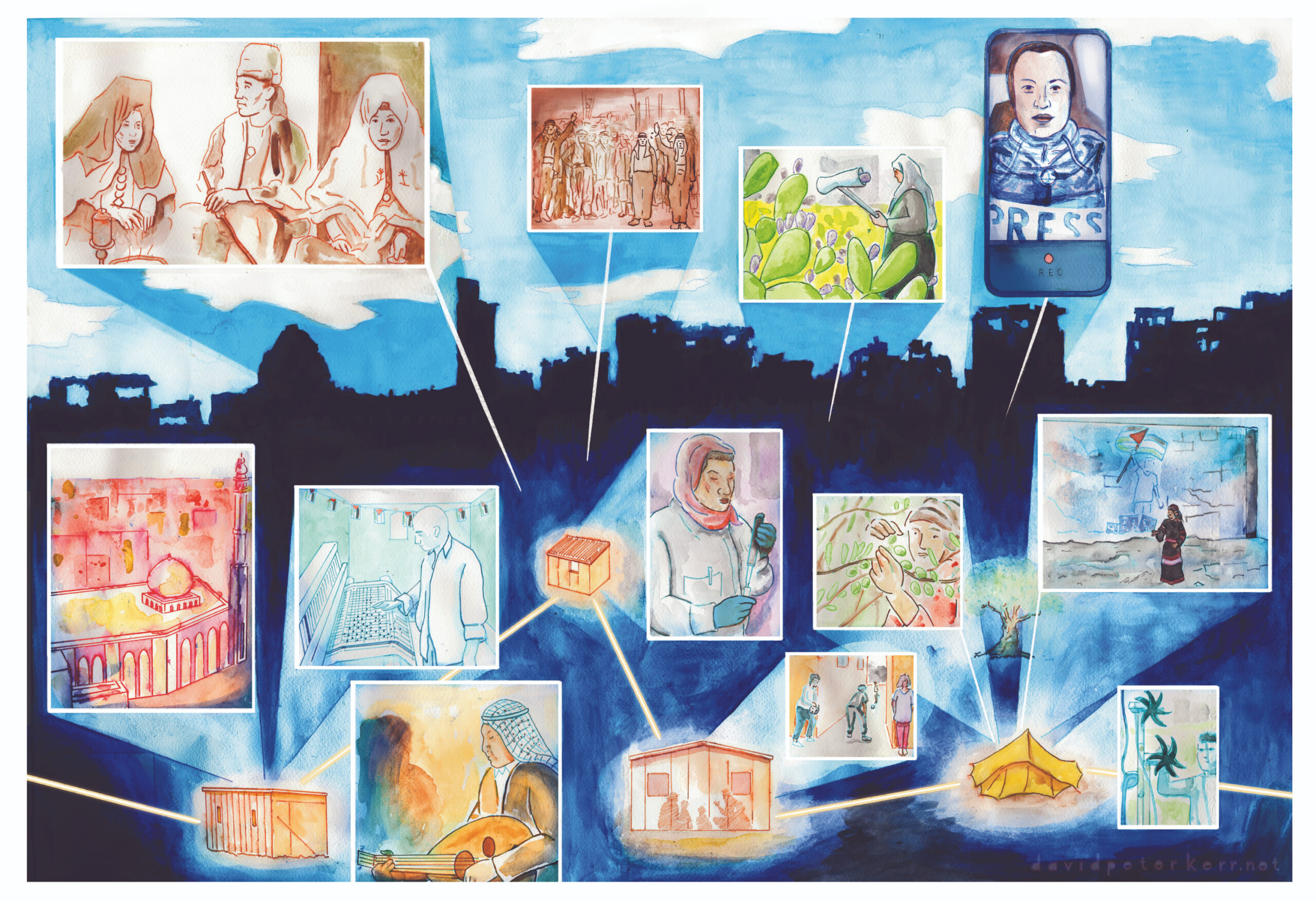
The contributions examine how Palestinian cities and communities have been shaped by genocide, colonial violence, displacement, destruction, and attempts to erase collective memory, while also emphasizing the resilience, resistance, and everyday survival practices that sustain Palestinian urban life. The contributions integrate studies of camps, housing, urban regeneration, solidarity networks, and memorialization to situate current events in urban Palestine within a longer history of settler colonialism. The cover illustration for this issue was made by our resident illustrator David Peter Kerr.
Urban Matters is also at the Nordic Geographers Meeting 2026 this week in Reykjavik with an exhibition of David’s illustrations and glimpses at Urban Matters editions through the years. If you find yourself in Reykjavik this week, you can find the exhibition at the University of Iceland in Háskólatorg.
Check out the editorial from the latest edition below, by Malmö Academics for Palestine:
Everywhere // Anytime: The Past, Present and Future of Urban Palestine
Palestine is everywhere, every hour of the day – in news tickers that report (or obscure) daily acts of Israeli aggression, on our social media feeds that feature pictures of a destroyed Gaza, martyred children, bulldozed olive trees, or moments and faces of resistance. It is on our streets and in public squares in Istanbul, London, and Malmö, in our universities, in our classrooms, in conversations with our children, and on our hearts and minds. Palestine provokes questions about our own humanity, statehood, and the meaning of social and ecological justice. It forces us to look not only at the present and to the future, but to turn our gaze to the past and to detangle the web of injustices spun from the late 19th century to the genocide of the 21st century.
In this special issue, we focus on urban Palestine – the histories and current processes of urbanization, the making and unmaking of its social, cultural, and physical geographies, and cycles of investment and disinvestment – all while amplifying Palestine’s existence beyond pity and despair.
As the contributions show, urbanity in Palestine has been forged by histories of colonial oppression and violence, displacement, enclavization, migration, repeated destruction of its built and natural environments and – as we are painfully witnessing – genocide and resistance. Genocides and other forms of ethnic cleansing produce their own urbanities through what has been referred to as colonial and post-urban destruction urbanism (Abujidi, 2014). As a tool of spatial dispossession and appropriation, “urbicide is used to un/re-make Palestine” as a project of settler colonialism (Abujidi, 2014).
Scholarship reminds us that genocides fundamentally target urbanity in all its facets (Shaw, 2004). Persecution, expulsion, and killing clear the way to redistribute land and engineer the forced depopulation and repopulation of spaces through settlements and camps (Katz, 2017; Vilenica & Mentus, 2025). When urban infrastructure is destroyed, human capability is destroyed with it (Graham, 2010). This deliberate displacement and dehumanization then fuels predatory speculation on property rights and sparks new public-private entanglements (Peyton, 2019). Crucially, as Ilan Pappé (2006) observes, this onslaught targets more than human life and concrete; it is an act of memoricide—the erasure of history and collective memory.
On the other hand, Palestinian urbanity cannot be reduced to the consequences of Israeli aggression. It is shaped by acts of resistance and everyday survival practices (Hasan & Bleibleh 2023), such as new forms of land appropriation and redistribution from below (Alkhalili 2017) and everyday means of “endurance” through which Palestinians “continue to continue” (Harker 2020: 6). Moreover, as Roy (2009) shows, urban planning in Palestine is infused with its own complex imagination. It lives both in the collective spirit of a people deeply bound to their (agricultural) land and in the ambitions of a local and international capitalist elite driving the production of abstract spaces (Roy, 2009; Dana, 2014). Indeed, Chitti and Moser (2019) have discussed how – pre-2023 – investments from Gulf countries have started to forge market-based urbanization processes, such as megaprojects in the West Bank. This urges us to rethink Palestine’s connection to global urbanization processes rather than reduce its urban realities to isolated moments of violent escalation.
This special issue collects reflections and engagements with urban Palestine that show the coexistence of colonial violence, urbicide, everyday survival, and resistance. Hammami explores the political centrality of camps, framing them not merely as sites of displacement, but as essential “infrastructures of political continuity and resistance” where heritage and urbanity materialize despite persistent violence. Hamed and Awad’s article investigates how the Beitin village has experienced colonial structural interventions, such as checkpoints, bypass roads, and land classifications, while navigating these with architectural modifications, emergency networks, and community resilience. Turning to urban regeneration, Kittana and Gola use a self-embodied research approach to unveil how urban revitalization in the Old City of Nablus takes place within ongoing conflicts and the everyday presence of urbicide. Based on their findings, they explain how any attempts at urban regeneration must be based in the already-existing, everyday collective endurance practices of Palestinians. In the context of housing, Vinik’s article addresses the intersection of international solidarity networks and platform short-term housing. She discusses how solidarity activists increasingly have turned to self-organized Airbnb accommodation in the West Bank. While platform capitalism might in this case enable activists to enter the field, it also, however, undermines historical solidarity networks and their infrastructure of training, support and protective presence. Chaker proposes that housing (re)development in Palestine (and Lebanon) takes place at the intersection of war and financialization. She asserts that housing production is not subsequent to a cycle of war-ridden destruction but is part of the same capitalist logic. Gren contributes with a photo essay in which she depicts the materialisation of Palestinian martyrdom, reflecting how collective mourning, celebration, and commemoration are visible and visibilized within the urban. Drawing together perspectives on urbicide, research methodologies, urbanity, resistance, and postcolonial understandings of sustainability, the interview with Abujidi then reconnects to the starting point of this editorial: “Palestine is everywhere.”
This special issue has come out of the collective work of Malmö Academics for Palestine, a collegial network working to increase the university’s awareness about Israel’s genocide and hold the university accountable for its collaborations with Israeli universities and businesses and for its inactions to support Palestinian scholars and students. With this special issue, we also want to make space for urban studies from Palestine, contextualizing the post-2023 period within a longer history of colonialism, urban warfare, housing (re)development, as well as everyday life and resistance.
As a last note, we encourage you to visit the Ambient Gaza project on Instagram (@ambient.gaza) or their website. This is an ambient music and soundmapping project that seeks to incorporate soundscapes and testimonies from Gaza. You will also find instructions to donate.
References
Abujidi, N. (2014). Urbicide in Palestine: Spaces of oppression and resilience. Routledge.
Alkhalili, N. (2017). Enclosures from below: The Mushaa’in contemporary Palestine. Antipode, 49(5), 1103-1124.
Chitti, M., & Moser, S. (2019). Emerging trends in urbanizing Palestine: neglected city-builders beyond the occupation. Urban Geography, 40(7), 1010-1017.
Graham, S. (2010). Disruption by design: Urban infrastructure and political violence. In Disrupted cities (pp. 123-142). Routledge.
Harker, C. (2020). Spacing debt: Obligations, violence, and endurance in Ramallah, Palestine. Duke University Press.
Hasan, D., & Bleibleh, S. (2023). The everyday art of resistance: Interpreting” resistancescapes” against urban violence in Palestine. Political Geography, 101, 102833.
Katz, I. (2017). ‘The Common Camp’: temporary settlements as a spatio-political instrument in Israel-Palestine. The Journal of Architecture, 22(1), 54-103.
Pappé, I. (2006) The Ethnic Cleansing of Palestine. Oxford: Oneworld Publications.
Peyton, D. (2020). Wartime speculation: property markets and institutional change in eastern Congo’s urban centers. In Urban Africa and Violent Conflict (pp. 19-39). Routledge.
Roy, A. (2016). Reimagining resilience: Urbanization and identity in Ramallah and Rawabi. City, 20(3), 368-388.
Vilenica, A., & Mentus, V. (2025). Urbanisation of racial capitalism in Serbia: Transition, racialisation, evictions. In Urban Marginality, Racialisation, Interdependence (pp. 42-61). Routledge.