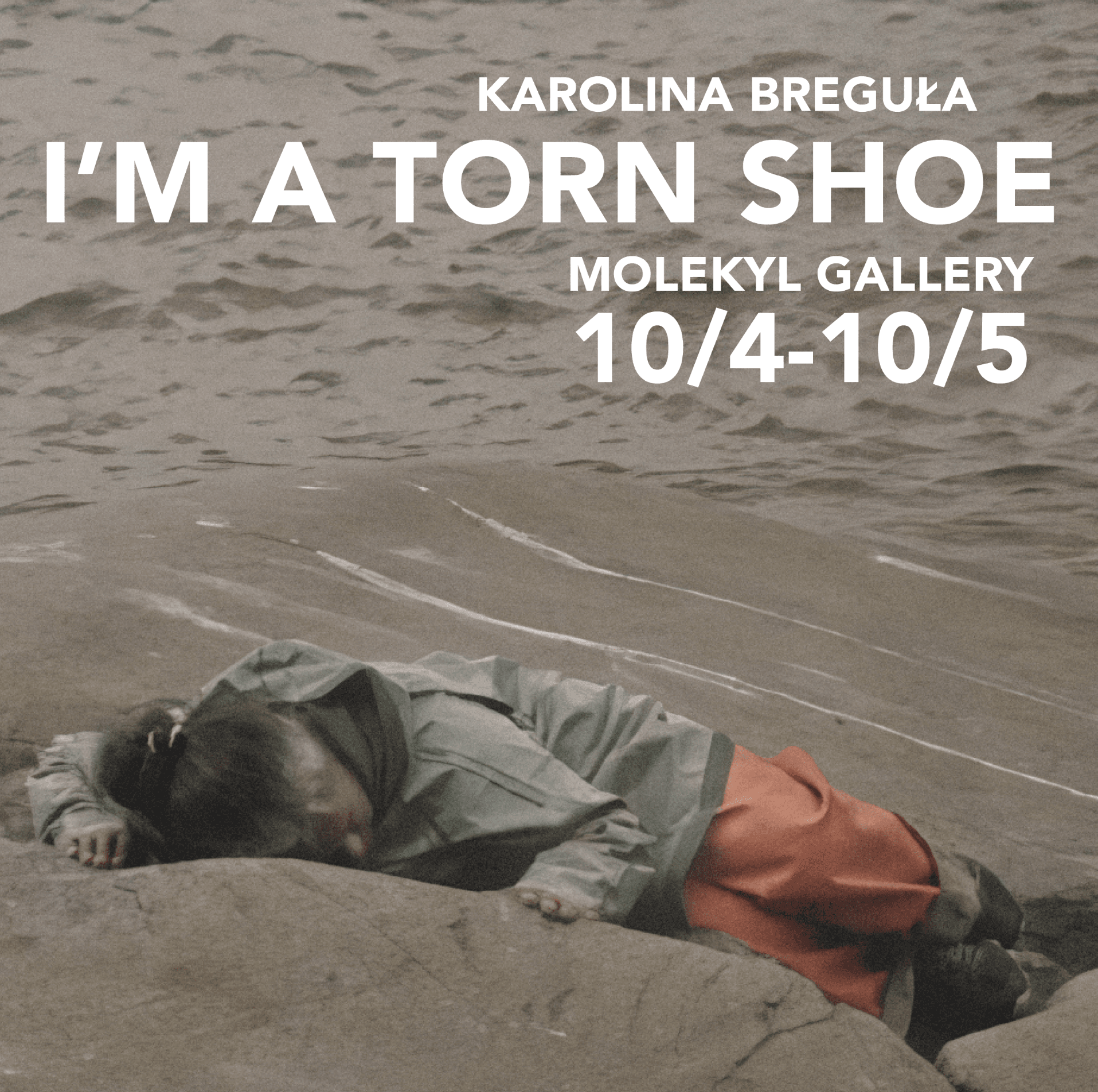
IUR’s 2023 artist in residence, Karolina Breguła, will have an exhibition entitled I’M A TORN SHOE at Mokeyl Gallery in Malmö (Båstadsgatan 4). The exhibition will open on Friday, April 10th from 17.00 – 21.00 and will remain at Molekyl until May 10th. The displayed work will include pieces worked on by Karolina during her residency at IUR.
About the artist:
Karolina Breguła (born 1979) is a visual artist and filmmaker. She creates stories about art, architecture and urban spaces, which are a field of her anthropological and sociological observations. She is interested in storytelling – the roles of retelling memories, the favourable and detrimental effect of fiction, the remedial and destructive force of imagination. She considers collaborative fiction writing a political activity which supports the process of diagnosing, expressing and discussing social problems. Many of her works are co-created with their protagonists and participants. Her works have been exhibited at institutions such as the Jewish Museum in New York, Museum of Contemporary Art MOCA Taipei, Tokyo Photographic Art Museum, Zachęta National Gallery of Art in Warsaw and at international events such as Venice Art Biennale and Singapore Biennale. She is the winner of the Views Deutsche Bank Foundation Award, the Samsung Art Master, the EMAF award, Golden Claw at the Gdynia Film Festival among others. She is an associate professor at the Academy of Art in Szczecin, Poland she collaborates with lokal_30 Gallery. Karolina works in Poland and Taiwan.
website: www.karolinabregula.com
instagram: @karolina_bregula
About I’M A TORN SHOE:
I’m a bamboo stick, I’m a dead fish, I’m a piece of styrofoam – the protagonists of The Tropic of Cancer list as they walk along the paths of a fishing village. Their home – shared with snails, crabs, and other creatures – stands low on the shoreline and was therefore flooded by the sea in the past. Now, time is about to begin moving backward and the protagonists understand that the water will return as well. They start to prepare, while military planes sweep across the sky like bats. Water, animals, plants, and objects washed ashore coexist in a state of anticipation, waiting for the transformation that the returning sea will bring. The Tropic of Cancer is Karolina Breguła’s latest work made in 2025 in collaboration with the inhabitants of Xincuo Village in western Taiwan.
The beach near their home – depicted in a photography series Low Tide – is a site of an old settlement. The remains of buildings used by the local fishing community in the past emerge from the sand. The sea washes ashore Pebbles formed from brick, concrete and asphalt. The Pebbles are the subject of the artist’s current research project.
The fisherwoman Manjula, the protagonist of The Fish, runs a small-scale fishing business in Köpmanholmen, near Örnsköldsvik, and has done so for over twenty years. Day by day, her trips to sea bring in smaller and smaller catches, until she eventually realizes that there are no fish left in the waters. Yet, with unwavering determination, she continues to set out from the harbor each morning, staying attuned to the changes unfolding in the Gulf of Bothnia. One day, when she finally spots a fish, she decides to follow it – she jumps in the sea and transforms into a sea being.
The film’s narrative is inspired by the real experiences of Swedish fisherwoman Manjula Gulliksson and her husband, Stefan Nordin. Observing the changes in marine life caused by industrial fishing, they have repeatedly written to authorities to raise the alarm. In the film, reality blends with haunting dreams born from their deep concern for the condition of the sea.
In her artistic practice, Breguła explores the experiences of people confronting social tensions, political issues, and the climate crisis. She follows the fate of Taiwanese houses marked for demolition, observes floods caused by rising sea levels, and documents the story of a Swedish fisherwoman navigating a sea devoid of fish. All her human and non-human protagonists accept the given state of the world, becoming part of it rather than resisting it, which Donna Haraway, a posthumanist theorist, would describe as “staying with the trouble” – a mode of inhabiting ongoing crises without seeking resolution, while remaining entangled, responsive, and accountable within a shared, more-than-human world.
Karolina Breguła seeks a language that allows us to understand and describe a rapidly changing reality – to depict a time of chaos and destruction without abandoning hope, and to initiate collective reflection. Her method is rooted in collaboration, collective storytelling, and the creation of spaces and pretexts for being together.