The call for abstracts is now open for a special issue of Urban Matters journal entitled Waste and Power: Critical Perspectives on Inequality and Exclusion,” edited by Kim Roelofs (University of Gothenburg). Please see the full call below:
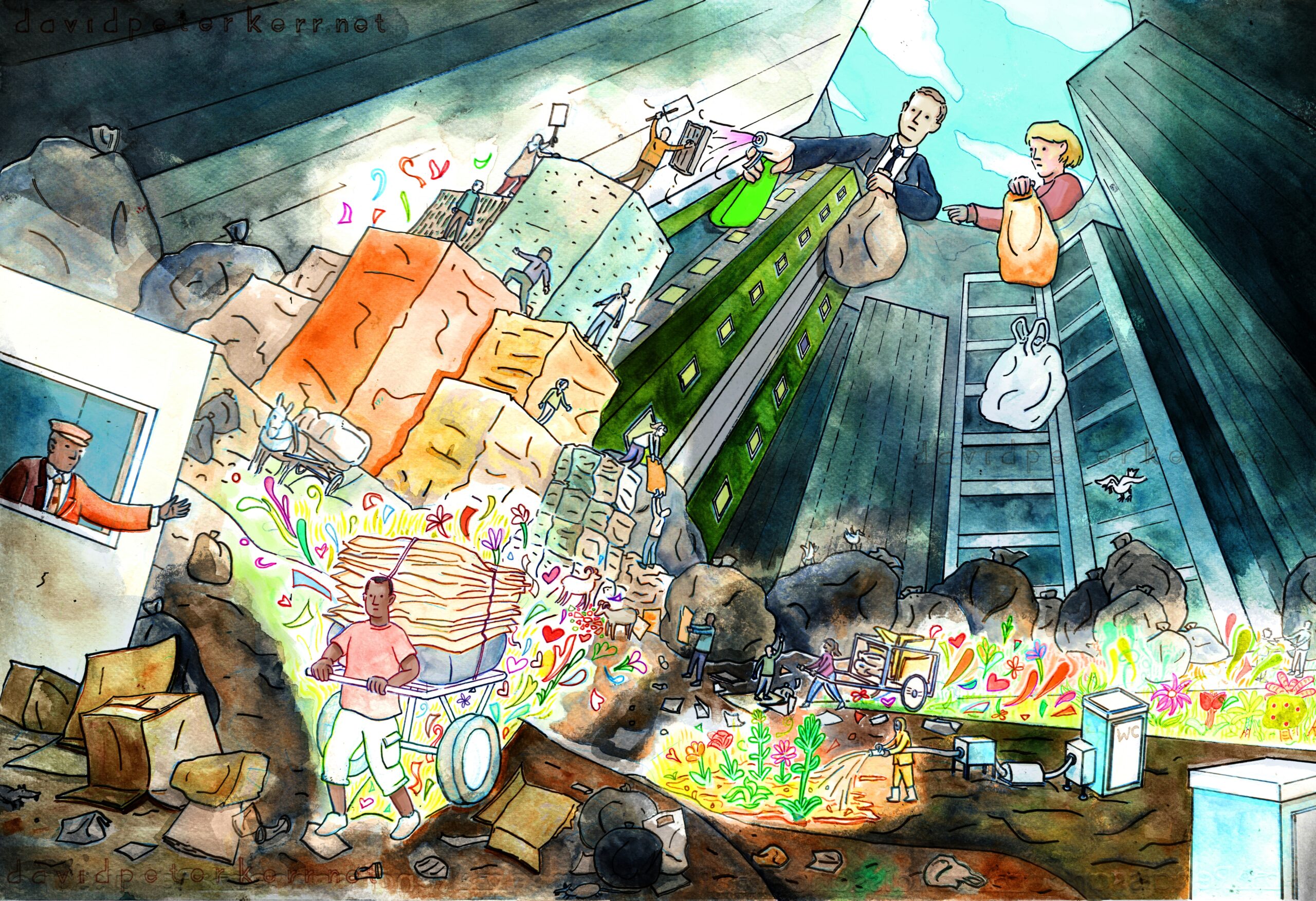
Waste is an everyday, material reality that confronts all people, though in unequal ways and with unequal consequences. Histories of dirt and cleanliness are histories of power: poor and racialized groups have both historically and in contemporary contexts been represented as dirty or not contributing sufficiently to sustainability goals (Bradley, 2009; Campkin & Cox, 2012; MacGregor et al., 2019). These representations have shaped (urban) policies around the globe, contributing to the exclusion of vulnerable groups (Baumann & Massalha, 2022), a focus on cleanliness to ‘teach’ people to be good citizens (Campkin & Cox, 2012; Nylander, 2018), and the stigmatization of places (Roelofs, forthcoming). Moreover, although most people engage in some form of cleanliness practices and managing dirt, dealing with dirt is unequally distributed along the lines of race, class, and gender (Campkin & Cox, 2012), where in particular poor, racialized women are forced to take on the majority of work related to taking care of (household) waste. Important work has been done on how waste and cleanliness practices structure cultures, maintain symbolic boundaries, and constitute waste handling subjects (Douglas, 2001; Hawkins, 2006; Shove, 2003). In all, waste and dirt are clearly not just questions of hygiene, but material and symbolic categories that can be used to exercise power on social groups and structure society.
In this issue, we aim to study waste and its intersections with (symbolic) power, stigmatization, and the consequences of different realities of waste on marginalized groups. We are interested in contributions that critically engage with questions of waste management, waste workers, and sustainability practices in the Global South and Global North. Possible focuses include (but are not limited to):
- People’s proximity to dirt, for example because of their place of residence or work, and the policy, material, and symbolic consequences of this.
- Waste management systems and infrastructure and its consequences for vulnerable and stigmatized groups and places.
- Waste and sustainability policies’ consequences for different groups and places.
Abstracts can be submitted to kim.roelofs@gu.se until October 25, 2025.
Successful submissions will be notified by the second week of November 2025.
Abstract: 250 words
Deadline for full-article submission: May 4, 2026
Tentative date of publication: August 2026
The Journal
Urban Matters journal is housed in the Institute of Urban Research, Malmö University. Urban Matters publishes original articles that have not been published elsewhere. It is a publicly accessible journal, including to non-academic publics, reflected in style, writing and online accessibility. Urban Matters publishes, besides research articles, photo essays, interviews, book reviews, and commentaries, and we encourage and welcome these forms of contributions. For more details on editorial policies see Urban Matters.
Works Cited
Baumann, H., & Massalha, M. (2022). ‘Your daily reality is rubbish’: Waste as a means of urban exclusion in the suspended spaces of East Jerusalem. Urban Studies, 59(3), 548-571. https://doi.org/10.1177/00420980211018642
Bradley, K. (2009). Planning for eco-friendly living in diverse societies. Local Environment, 14(4), 347-363. https://doi.org/10.1080/13549830902764738
Campkin, B., & Cox, R. (Eds.). (2012). Dirt: New geographies of cleanliness and contamination. I.B. Tauris.
Douglas, M. (2001). Purity and danger: An analysis of concept of pollution and taboo. Routledge. (Original work published in 1966)
Hawkins, G. (2006). The ethics of waste: How we relate to rubbish. Rowman & Littlefield.
MacGregor, S., Walker, C., & Katz-Gerro, T. (2019). ‘It’s what I’ve always done’: Continuity and change in the household sustainability practices of Somali immigrants in the UK. Geoforum, 107, 143-153. https://doi.org/https://doi.org/10.1016/j.geoforum.2019.09.013
Nylander, O. (2018). Svensk bostadsarkitektur: utveckling från 1800-tal till 2000-tal [Swedish housing architecture: Development from 19th century to the 21st century]. Studentlitteratur.
Roelofs, K. (forthcoming). Waste, security and stigmatization: How housing companies understand the problem of waste in marginalized areas.
Shove, E. (2003). Comfort, cleanliness and convenience : The social organization of normality. Bloomsbury Publishing. http://ebookcentral.proquest.com/lib/gu/detail.action?docID=243469